I believe in a pious, sophisticated, elegant, accountable, amicable and strong woman. I believe in the woman who is able to stand up for herself. I believe in the woman who doesn't need to hide behind her husband's back. I believe in the woman who is capable of fighting any ill-fated event whether it is domestically or externally. I believe in the woman who is able to stand with and express solidarity with her lovely husband when he has been in the state of the unbridled problem, facing financial hardships as well as being enmeshing in mentally disturbing and physically painful as well. It is because of the fact that marriage life is the unbreakable bond of lasting friendship which only will grow deeper and stronger. It is believed that marriage life to have been built on shared belief in human dignity, and shared love of freedom as well as combination of truthfulness and trustworthy, sacrosanct, unwavering, and unshakable in which both strongly believe in mutual cooperation and serenity, mutually perceived way of life which is based on premise in ideological indifferences, acknowledging same religious set of beliefs and God-conscious oriented life as well. In addition to, both believe in working closely to weed out any indifferences immediately in any matters that might be harmful for relationship, participating mutually to work at home. Most importantly, both strongly believe in not indulging any rumours ,speculation currency etc., which is detrimental to relationship, these acts are total and complete baseless, wild, unsubstantiated, false and immoral as well as unethical. But believe in your heart don't I believe that if you have problems, as a woman you deal with them you don't play victim you don't make yourself look pitiful you don't point fingers. You stand and you deal. You face the world with a head held high and you carry the universe in your heart. I believe in all women, including the ones who have had their strength drained from them and are in need of the strength of each other, of the comfort of their husbands, of being soft when needed, of being gentle and being the part of the family that balances the harder strength of the husband. I believe that women can be strong, and still have the need to seek comfort and help and accept it when it is given to her from the Mercy of Allah. All women are people I believe have worth, all women matter and have their special place and precious gifts to share.
The increasingly forging ties with Russia on major international issues such as Syria, also an immediate neighbor of Turkey that seems to have reflecting bringing peace and stability in Syria. Paradigm shift of Ankara’s policy pertaining to Syrian president Assad is also the reflection of the same. Because of the fact that Russia has played a profound and vital in giving detail intelligence information about coup plotters. After failed-coup, the first foreign tour of Erdogan was Russia in which both were agreed to establish a sustained, substantive and constructive diplomatic relations. Now both nations have attained a new level of understanding friendship and strategic depth.
Both decided to work closely to boost counter-terror and insurgency cooperation including effective information sharing and capacity building.They agreed to cooperate closely to promote peace and stability in war-ravaged Syria and bringing the civil war to end.Moreover, both Ankara and Moscow are agreed to intensify their cooperation against international terrorism and pledged to pulverize ISIS. Before long they are going to have been turned Daesh’s phony caliphate to dust. The burgeoning and deepening the Turkish-Russian military entente will add a further dimension to the overall. In the long run, it would result in bringing peace and prosperity, stability in the regions.
Their relationship are based on deeper economic engagement, growth of trade and tourism industry, a continued bolstering anti-terror operations, manufacturing and investment ties as well as partnership to increase cooperation in the field of oil and gas.
Upcoming constitutional referendum
The constitutional referendum is scheduled to take place in June 2017. If it would succeed, then it is going to put the final nail in the coffin of so called country’s western democracy. But at the same time it must be emphasized that it would pave the way for bolstering the spiritual democracy which is based on the values and morals of Turkish culture and society. They will grant the president full executive powers, abolish the post of Prime minister, and significantly reduce the powers of parliament. In addition to, it will give the unprecedented and unbridled rights to the president that has power and authority to dissolve parliament, veto legislation, decide the budget and appoint ministers as well. Sometimes it becomes necessary to take tough and appropriate steps to save country’s unity and integrity. It is well said that changing rules for changing needs and unchanging rules for unchanging needs. If Erdogan would succeed in upcoming referendum, then it will be an unprecedentedly radical shift for post-Kemalist Turkey.
Security and foreign policy perspectives
In context of security, terrorism will continue to remain a grave threat during 2017. Innocent Turkish people unfortunately will continue to bear the brunt of IS and Kurdish terrorist attacks. Because Turkey surrounding with decimated old middle east region, and situated at a strategically important with complicated regions. President Erdogan should use all his tools to eliminate terrorism from Turkish soil whether these tools could be political, humanitarian, economic, law enforcement or intelligence. Erdogan should urge all the Muslim leaders especially in the Middle East region and bring together all to oppose IS nihilistic vision and genocidal agenda, to demolish their revenue sources, to kill Daesh’s leaders, to curb their recruitment as well as rebut their poisonous ideals and chaotic ideologically ideas as well. They are undoubtedly a genocidal enemy of Muslim Ummah. The fact of the matter is that Erdogan was possibly one of the few world leaders that admitted the nature of the tectonic shift across the globe. Also, he is one of the few leaders all over the world that has a profound grasp of geopolitical manoeuvring, the fulcrum of geostrategic imperatives as well as modern warfare doctrines.
It is very sad to say that within the Muslim world Saudi Arabia, Turkey and Iran are major players instead of resolving the problems; they are battling amongst each other to grip the crumbling old Middle East and jostling each other to spread the sphere of influence in already decimated and devastated Muslim world.
The New Year’s Eve attack on Istanbul nightclub that killed at least 39 people and wounded many people, most of them were foreigners. Ankara and Istanbul have been targeted by several terrorist attacks in 2016 carried out by the Islamic State group or Kurdish rebels, killing more than 180 people. Turkey is a member of the NATO alliance and a partner in the US-led coalition fighting against IS group in Syria and Iraq, in another front, it is also actively involved launching an incursion into Syria in August 2016 to drive the other radical Sunni militants from its borders. Turkey has lost more than 260 people in terror attacks at different locations since Jan 2016. How has turkey a politically stable with a booming economy descended into instability and chaos?
The outlook for Turkey in 2017 is anything but optimistic, with a declining tourism industry, widening terror footprint, escalating internal insurgency and ambitious geopolitical realignments in the Muslim world, deepening diplomatic rapprochement with Russia as well as cementing toward neo-ottomanism dream that would shape Turkey’s future policies and programmes.
Moreover, the major geopolitical challenges of 2017 that could seriously change the balance of power in the international arena are one of the dramatic changing situations in Turkey. 2016 was one of the worst years in terms of fatalities in Turkey.
Economic perspective
Turkish tourism industry is adversely affected by a serious of the terrorist bombing that stormed its capital Ankara and the main economic hub and crowding city Istanbul. The tourism economy of Turkey which makes a fairly large contribution to its GDP. A large of tourist comes from Russia that also forced Turkish President Erdogan to forge ties with Moscow in the field of tourism, trade, and commerce. Both countries agreed to cooperate closely to promote tourism culture and enhance investment in the regions.
Political and Islamic perspective
Political stability and economic stability are partners. Geopolitical and strategic imperatives will continue to remain the deciding factor in shaping the Turkey’s internal political stability and peace. Geopolitical risks will continue to be critical challenges for Erdogan in 2017 to preserve country’s unity and territorial integrity. For the sake of Turkey’s stability, peace, and prosperity, it is to be ensured that Turkish president Erdogan should immediately shut down the U.S., military base which is located in Incirlik. As long as it remains to exist on Turkish soil, it will be providing a safe haven for coup plotters and anti-Turkish elements. As a result of this, Erdogan will remain to face the threat of coup. Because of the fact that Turkish military establishment is still a secular institution and suspicious of his Islamist beliefs. The current civilian establishment is pro-Islamic regime and also expected to lean towards instilling Islamic political system which is premised on the principle of gender justice and co-existence as well as a beacon of tolerance.
That’s first thing and second thing is that he should give up on his EU bid. In quest of entering EU for a long time is a wishful strategy, the fact is that members of EU are not going to accept Turkey as an EU member because Turkey is a Muslim country and also Erdogan’s domestic policy reflecting on strengthening Islamic social system.
It is an Islamic transnational religious and social movement led by Turkish preacher Fethullah Gulen, who has lived in the United States since 1999.
The movement has attracted supporters and critics in Turkey, Central Asia, and other parts of the world.
It is active in education with private schools and universities in over 180 countries as well as many American charter schools operated by followers.
Despite its teachings that are considered conservative even in Turkey, some have praised the movement as a pacifist, modern-oriented version of Islam, and as an alternative to more extreme schools of Islam such as Salafism.
The Gulen movement is a former ally of the Turkish Justice and Development Party (AKP). When the AKP came to power in 2002 the two formed, despite their differences, a tactical alliance against military tutelage and the secular elite.
It was through this alliance that the AKP had accomplished an unprecedented feat in Turkish republican history by securing national electoral victories sufficient to form three consecutive majority governments in 2002, 2007, and 2011.
The Gulen movement gained influence on the Turkish police force and the judiciary during its alliance with conservative President Erdogan, which saw hundreds of Gulen supporters appointed to positions within the Turkish government.
Once the old establishment was defeated around 2010 to 2011 disagreements emerged between the AKP and the Gulen movement.
Since 11 December 2015 the Gulen movement is classified as a terrorist organization in Turkey.
After the failed coup attempt in 2016, the government of Turkey blamed the group for the coup and authorities have arrested thousands of soldiers and judges.
Over ten thousand education staff were suspended and the licenses of over 20,000 teachers working at private institutions were revoked for alleged affiliation to Gulen.
Fethullah Gulen strongly condemned the coup, and rejected claims of his involvement.
Lurid Headlines, Blatant Falsehoods, Media Trials, Sensation Sans Sensitivity, Manipulation of Mind, Propagating Psychological Warfare, Fomenting Communal Tension rather than Communal Amity, Creating Outrage rather than Awareness as well as Spreading Biased News rather than Objectivity have become the everydayness of routine in mainstream media in all over the world.
The media and journalism should imbibe the five core tasks viz. identify verification, sense making, bearing witness, putting facts and events and investigation. These core tasks will be the foundation as well as bottom line on which whole press in the modern and digital age is going to be rebuilt completely. The work of media is to have been digging deep, truth seeking, placing facts and events in context and in historical perspective, profound insight into the events and adhering to wisdom-oriented as well. They should not have lack of credible and trustworthy information, sequestered discipline and prejudiced manner in making and reporting news. They should have right to analysing and commenting independently and freely, acting justly, humanely and ethically. These rights should become an integral part of journalism. The duty of journalism has to be imbued with freedom, humanity, bias-free, norms and ethics in addition to justice.
I am deeply saddened by the on-going debate of nationalism, especially by the certain elements of media in which they have been repeatedly saying and giving certificate of nationalist. This is out and out terrifying. Recently in the case of the surgical strike in which some sections of media and TV news have been deliberately fomenting and inflaming jingoism. That would result in ultra-nationalism, further which in turn fascist idea. The time has come when this blatant hypocrisy of media should come to an end. They should respect different and divergent view of people. Some groups of TV are obsessed with national security concerns, as a result of this, they always indulging in reporting of false news and creating panic among people. Nowadays it became very common that media is about getting ratings, about making money, about doing stories that are easy to cover and keeping them in a uproar.
The work of media should be to expose scandals, conduct campaigns against those who are desperately and deliberately trying to subvert the constitutions of a nation, to coerce the Government to conform to what it asserts and promises made during election campaigns to be the will of the people and to create awareness about Government’s policies and programmes. I always remember the quote of Turkish Novelist Mehmet Murat, very nicely said about media that “Unless you have a free press in your country, there is no need to buy newspapers and there is no need to watch the news because there is no need to listen to the lies! And you already have one real information: You are being deceived by the people you are governed! This is an enough information for you!”
I am very saddened and with deep sorrow to learn about the demise of a great Islamic scholar as well as a preacher of the most authentic book of hadith Sahih Bukhari, Maulana Abdul Haq Azami. He has been preaching at the world’s most prominent Islamic seminary Darul Uloom Deoband for a long time. As a matter of fact, Darul Uloom Deoband, in the sub-continent, is the largest institution for the dissemination and propagation of Islam and the biggest headspring of education in the Islamic sciences. He passed away today in his house at Deoband at the age of 88 years old. He has left for his heavenly abode. In fact, Darul Uloom Deoband suffered a bereavement and personal loss due to his death. We pray to Allah Almighty to give Deoband enough strength and courage to bear this irreparable loss. His great deeds done for Muslim Ummah and the Madrasa shall always remain alive. He has made a valuable and reliable contribution to the cause of the preservation of the Islamic way of life in India and elsewhere.
Indeed, in a palpable term, he is the true inheritor of the intellectual and spiritual legacy of Imam Rabbani Mujaddid Alf-Sani(r.a). He has an unbounded and heartfelt love for Allah and His Prophet Muhammad(Peace be upon him). He has been a source of much inspiration and motivation among his students and followers both in theoretical and practical matters. He was a pragmatist, down to earth, amicable and friendly towards both his enemy and follow mate. Moreover, he was a man of constructive action, rational and scientific outlook and a tolerant attitude during his preaching. He always propagated and disseminated the truth in the light of the Book of Allah and the Sunnah(teachings and practices of Prophet peace be upon him). Because of the that Allah has given him extraordinary knowledge of Hadith, as well as Fiqh. As a result of this,he dented a big blow to heretical movement and deviant sects.
There is a need to be cognizant of the fact that Islamic scholars have always been playing a crucial role in the teaching of the Divine Book of Allah, The Quran, and the Sunnah of His Prophet as well. They have always been endeavoring to keep the Islamic belief, norms and faith in its original form and to preserve the tenets of Islam, in addition to inculcating a spirit of tolerance among his students and followers. They are the chosen people of Allah, Allah has chosen them for his work(spreading the truth and peace of religion i.e., #Islam). It will be day of judgment, when the Ashab As-Suffa will be stood there, then Allah will ask "tell me what did you bring?" at that time these students(Preacher and propagator of Islam) will be standing as well. These students will say that Allah in knowledge and practice we were not able to follow them(God conscious and pious persons in Islam) as they should have been followed, but O Allah we tried to follow their footsteps.
May Allah give his ultimate peace and grant him a top layer of paradise.
If Moscow declaration is to accomplished, then its impact could be far beyond what we are expecting. On the one hand Moscow declaration will yield positive result on Syrian fate, on other hand it can pave the way for the ending of Syrian civil conflict. If it succeeds what i meant to say that it, in fact, would be gone down in history as a memorable and remarkable day to turn the tide of Syria’s conflict. Russia, Turkey and Iran adopted a declaration on the immediate steps to promote the settlement of the Syria’s crisis.
The Ministers of Foreign Affairs of the Islamic Republic of Iran, the Russian Federation and the Republic of Turkey, met in Moscow on 20 December 2016, agreed on the following.
1. Iran, Russia and Turkey reiterate their full respect for sovereignty, independence, unity and territorial integrity of the Syrian Arab Republic as multi-ethnic, multi-religious, non-sectarian, democratic and secular state.
2. Iran, Russia and Turkey are convinced that there is no military solution to the Syrian conflict. They recognize the essential role of the United Nations in the efforts to resolve this crisis in accordance with UNSC resolution 2254. The Ministers also take note of the decisions of the International Syria Support Croup (ISSG). They urge all members of the international community to cooperate in good faith in order to remove the obstacles on the way to implement the agreements contained in these documents.
3. Iran, Russia and Turkey welcome joint efforts in Eastern Aleppo allowing for voluntary evacuation of civilians and organized departure of armed opposition. The Ministers also welcome partial evacuation of civilians from Fuaa, Kafraia, Zabadani and Madaya. They commit to ensure the completion of the process without interruption and in a safe and secure manner. The Ministers express their gratitude to the representatives of ICRC and WHO for their assistance in conduction of the evacuation.
4. The Ministers agree on the importance of expanding ceasefire, unhindered humanitarian assistance and free movement of civilians throughout the country.
5. Iran, Russia and Turkey express their readiness to facilitate and become the guarantors of the prospective agreement, being negotiated, between the Syrian Government and the opposition. They invited all other countries with the influence on the situation on the ground to do the same.
6. They strongly believe that this Agreement will be instrumental to create the necessary momentum for the resumption of the political process in Syria in accordance with the UNSC resolution 2254.
7. The Ministers take note of the kind offer of the President of Kazakhstan to host relevant meetings in Astana.
8. Iran, Russia and Turkey reiterate their determination to fight jointly against ISIL/DAESH and Al-Nusra and to separate from them armed opposition groups.
Disturbing your wife even in the state of slumbering or sleeping is also a bad deed. Do not disturb your wife even she is slumbering, a condemnable as well as dastardly despicable act in front of ALLAH. A very fascinating and well-documented, prominent hadith of Muhammad (Sallallahu alaihi wasallam), in which Hazrat Ayesha may ALLAH be pleased with her narrated that,” once I was sleeping on my bed and Prophet Muhammad peace be upon him was also sleeping on the same bed. And he (PBUH) wanted to get up for night prayer. So I was seeing that Prophet (PBUH) was moving so peace and tranquil, even softly that I was anxious what Prophet is doing. Prophet moved very softly until he went away from the bed. Then Prophet walked and opened the door so softly that there should not be made any noise. He went out and she said that I started thinking why Prophet did like that? And I got up and followed him. He went to Jannatul Baqi and there he made dua. So I came back on my bed before him. When Prophet came back, I asked him “oh Prophet of ALLAH (SWT) why you did like that. Prophet replied, “Ayesha, you were sleeping and I never wanted to disturb you. This is the action of Prophet. This is also the legacy of Islam. He never wanted to disturb the sleep of his wife. And we want to disturb the life of our wife on small things. Even we always do shouting, crying and abusing our wife and stop talking on them on very small and minor things. This is our behaviour and manner.
We feel that we are very good Muslims. We do not even comply with the definition of the Muslims. What I meant to say that it is shameful for us saying we are good Muslims. Because of the fact that we have been, at very small mistakes of women, never leaving a chance to humiliate, degrade, subjugate, discredit, and insult them. We have to upgrade and uplift her, need to cast a spell on her by our manner of behaviour and on moral high ground.
Syria has been engulfed in political violence since 2011. It has disintegrated into a cauldron of competing rebel groups, terrorist elements, international powers, and religious factions. Further, the Syria conflict is compounded by Syria’s ethnic divisions and sectarian lines. Despite the fact that the most of the Syrian population are Sunni Muslim which accounts for 75 percent of the population, a majority population has been ruled by a harsh authoritarianism regime of Asaad dynasty(Alawites sect) which comprises merely 12 percent of Syrian’s population. Laconically, I introduce the current Syrian dispensation, Assad regime is brutal, savagely fierce, an awful lot of insidious and racist, violent terror, incivility, inhuman, discriminatory, despotic, and alien in its own nature, character as well as outlook. Moreover, it has adversely affected every section of its population. As a result of this, a strong sense of anti-regime resentment developed among the people and bursted out in the form of popular uprising. Syrian President Assad himself responsible for making the country in a form of ravaged, decimated and failed state as well by doing unbridled air bombing on his people and opponents.
As and when political protest spread across the full spectrum of Syria against the four-decade rule of the Assad family, this rampant political protest penetrated into political violence. Because of an incompetent of Assad regime, Syrian president Bashar al-Assad has completely failed to resolve the popular demand of public. Unfortunately, political violence plunged into civil war. As a result of this, hundreds of thousands of Syrians have been killed, estimated to half million people in internal civil strife and more than twelve million people i.e., more than half the country’s pre-war population have been displaced. In fact, the Syrian civil war is arguably the worst humanitarian crisis since the world war two. Regional and international powers have been intensely supporting severals local militant groups to advance their geopolitical interests on the Syrian battlefield. Now, Russia has been at the forefront of supporting egregious and ruthless Assad regime to reinforce its geopolitical ambitions and interests in the volatile region of the Muslim world. The Russian military has been conducting indiscriminate air strikes against civilians, hospitals, community centers and medical facilities as well as humanitarian aid convoys for several weeks in and around the Aleppo city.The same things did in the past by American army. There is no difference between the United States and Russia in terms of using of air power assets against civilian populations. The situation in Syria has never been more dire. This is even more true in Aleppo, where civilian causalities are rising at alarming numbers due to air strikes perpetrated by the Syrian Regime and Russian Forces. We are witnessing a profound surge of violence against civilians, health workers, patients, humanitarian convoys,and medical facilities across the length and breadth of the country. The modus operendi of conducting bombing that is both physically horrific and morally reprehensible and seeks international community to punish those who killing innocent people in Syria. After all, Syrian people want peace, not war.
A 38-year-old man told Amnesty: “My sister and brother were both kidnapped by the army. I saw with my own eyes how the military burned down our village, and how soldiers raped women and girls.”
Another man, aged 58, said: “We saw helicopters firing on the village. We ran into the forest to save our lives.”
A woman aged 44 said soldiers had handcuffed young men in her village before shooting them dead and pushing their bodies into mass graves.
“The response of the army to the attacks on security forces six weeks ago went far beyond what was necessary and proportionate,” said Patel. “Instead of investigating and arresting specific suspects, the army carried out operations amounting to collective punishment.”
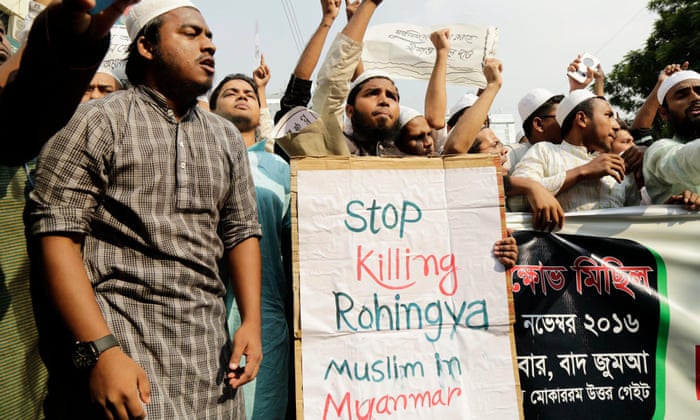
There are about 1 million Rohingya in Myanmar who are denied citizenship. Hundreds of thousands have fled to Bangladesh, many of whom live in camps in Cox’s Bazaar. The Bangladesh government has refused to grant refugee status to Rohingya arriving from Myanmar since 1992.
Thousands of Rohingya Muslims who have fled to Bangladesh from Myanmar where they have been attacked by security forces are being pushed back by the Bangladeshi authorities, according to Amnesty International.
Those that do make it to makeshift camps in the town of Cox’s Bazaar are facing shortages of food and water, and some are suffering from severe malnutrition.
The Rohingya are fleeing military operations in Myanmar in which scores of people have been killed and as many as 30,000 displaced. The attacks are in reprisal for an assault on three border posts last month that left nine Myanmarpolice officers dead, but the Rohingya have been persecuted in the country for years.
Bangladeshi border guards have detained and forcibly returned hundreds of people, Amnesty said on Friday. The actions were in violation of international law, which prohibits the return of people to a country or place where they are at serious risk, it added.
“The Rohingya are being squeezed by the callous actions of both the Burmese [Myanmar] and Bangladesh authorities,” said Champa Patel, Amnesty’s South Asia director.
“Fleeing collective punishment in Burma, they are being pushed back by the Bangladesh authorities. Trapped between these cruel fates, their desperate need for food, water and medical care is not being addressed.”
She added: “The Bangladeshi government must not add to the suffering of the Rohingya. They should be recognised and protected as refugees fleeing persecution, not punished for who they are.”
Aung San Suu Kyi, Myanmar’s de facto leader, has been criticised for not doing more to end the military actions, which – according to witness accounts given to Amnesty – include firing at villagers from helicopter gunships, torching hundreds of homes, carrying out arbitrary arrests and raping women and girls.
The Myanmar government has denied allegations of human rights violations by the military and has accused “Rohingya lobbyists” of disseminating fabricated accounts. Access to the area for aid workers, human rights monitors and independent journalists is effectively barred, said Amnesty.
Myanmar is seeking the ethnic cleansing of the Muslim Rohingya minority from its territory, a senior UN official has told the BBC
Armed forces have been killing Rohingya in Rakhine state, forcing many to flee to neighbouring Bangladesh, says John McKissick of the UN refugee agency.
The government of Myanmar, also known as Burma, has been conducting counter-insurgency operations since coordinated attacks on border guards in October.
It denies reports of atrocities.
A spokesman said the government was "very, very disappointed" by the comments.
Burmese officials say Rohingya are setting fire to their own houses in northern Rakhine state. The BBC cannot visit the area to verify what is occurring there, as journalists and aid workers have been barred.
The Rohingya, who number about one million, are seen by many of Myanmar's Buddhist majority as illegal migrants from Bangladesh.
Media captionRohingya Muslims 'hated and hounded from Burmese soil'
Although Bangladesh's official policy is not to allow in illegal entrants across the border, the foreign ministry has confirmed that thousands of Rohingya have already sought refuge in the country, while thousands more are reportedly gathering on the border.
Efforts to resolve the issue must focus on "the root cause" inside Myanmar, Mr McKissick, head of the UN refugee agency UNHCR in the Bangladeshi border town of Cox's Bazar, told BBC Bengali's Akbar Hossain.
He said the Myanmar military and Border Guard Police had "engaged in collective punishment of the Rohingya minority" after the murders of nine border guards on 9 October which some politicians blamed on a Rohingya militant group.
Security forces have been "killing men, shooting them, slaughtering children, raping women, burning and looting houses, forcing these people to cross the river" into Bangladesh, Mr McKissick said.
"Now it's very difficult for the Bangladeshi government to say the border is open because this would further encourage the government of Myanmar to continue the atrocities and push them out until they have achieved their ultimate goal of ethnic cleansing of the Muslim minority in Myanmar," he said.
Where is Aung San Suu Kyi? - BBC Myanmar Correspondent Jonah Fisher
Nobel laureate Aung San Suu Kyi is in a delicate position. She is Myanmar's de facto leader, but security is under the control of the autonomous armed forces.
If Ms Suu Kyi bows to international pressure and sets up a credible investigation into the alleged abuses in Rakhine state, she risks fracturing her relationship with the army. It could jeopardise the stability of her young government.
So for the last six weeks Ms Suu Kyi has kept her head firmly in the sand, avoiding journalists and press conferences.
When forced, she has commented that the military in Rakhine is operating according to the "rule of law". Few believe that to be the case.
While there are loud calls from overseas for action, most Burmese have very little sympathy for the Rohingya. The army's "clearance operations" against the "violent attackers" of Rakhine state appear to have strong popular support, putting Ms Suu Kyi under very little domestic pressure.
Myanmar's presidential spokesman Zaw Htay said Mr McKissick "should maintain his professionalism and his ethics as a United Nations officer because his comments are just allegations".
"He should only speak based on concrete and strong evidence on the ground," he said.
On Wednesday, the Bangladesh foreign ministry summoned Myanmar's ambassador to express "deep concern" over the military operation in northern Rakhine state.
It said "desperate people" were crossing the border seeking safety and shelter and asked Myanmar to "ensure the integrity of its border".
Authorities in Bangladesh have been detaining and repatriating hundreds of fleeing Rohingya, which Amnesty International condemned as a violation of international law.
Bangladesh does not recognise Rohingya as refugees, and many of those fleeing Myanmar have been "forced into hiding and are suffering a severe lack of food and medical care", the rights group said.
Rohingya refugees and asylum-seekers have arrived into Bangladesh from Myanmar in waves since at least the 1970s. There are some 33,000 registered Rohingya refugees living in Cox's Bazar's two camps, Kutupalong and Nayapara.
Earlier this week, Human Rights Watch released satellite images which it said showed that more than 1,200 homes had been razed in Rohingya villages over the past six weeks.
Image copyrightHUMAN RIGHTS WATCHImage captionA satellite image of the village of Wa Peik, Maungdaw district on 10 NovemberImage copyrightHUMAN RIGHTS WATCHImage captionThe same area pictured in a satellite image recorded on 18 November
What is happening in Rakhine state?
A massive security operation was launched last month after nine police officers were killed in co-ordinated attacks on border posts in Maungdaw.
Some government officials blamed a militant Rohingya group for the attacks. Security forces then sealed off access to Maungdaw district and launched a counter-insurgency operation.
Rohingya activists say more than 100 people have been killed and hundreds arrested amid the crackdown.
Soldiers have also been accused of serious human rights abuses, including torture, rape and executions, which the government has flatly denied.
It says militants have attacked helicopter gunships providing air support to troops.
Who are the Rohingya?
The estimated one million Muslim Rohingya are seen by many in mainly Buddhist Myanmar as illegal migrants from Bangladesh. They are denied citizenship by the government despite many having lived there for generations.
Communal violence in Rakhine state in 2012 left scores dead and displaced more than 100,000 people, with many Rohingya still remaining in decrepit camps.
They face widespread discrimination and mistreatment.
Hundreds of thousands of undocumented Rohingya are estimated to live in Bangladesh, having left Myanmar over decades.
Is the government to blame?
Myanmar held its first openly contested election in 25 years last November, with Nobel Laureate Aung San Suu Kyi's National League for Democracy winning a landslide victory.
Though she is barred from the presidency due to a constitutional rule, Ms Suu Kyi, who serves as State Counsellor, is seen as de-facto leader.
But her government, led as it is by a former human rights icon, has faced international criticism over the dire situation in Rakhine state.
Rights groups have questioned why journalists and aid workers are not being allowed to enter northern Rakhine.
Presidential spokesman Zaw Htay says the international media is misreporting what is going on.
The sun might have set on the formidable British empire, but not on its legacy.
Many of the present day conflicts around the world have deep-seated links with British colonial polices, their mismanagement of the process of independence, and the legacy they left behind in law, by drawing up unviable borders and by migrating cheap labour from one colony to the other.
Shashi Tharoor’s book, ‘An Era of Darkness: The British Empire in India’,scheduled to release next month, is expected to talk about the colonial looting of India.
But while it’s up to these erstwhile colonies now to resolve matters on their own and the blame cannot forever lie with the British, in many situations the roots of the conflict lie in imperialism.
Here’s a list of 7 present day conflicts around the world triggered and often exacerbated by the English colonisers.
1. No Country for Rohingyas
Discriminated against for years, the Rohingyas of Myanmar have been classified by the United Nations as one of the ‘most persecuted refugee groups in the world’.
But their origin in fact has been disputed since the British conquest of Arakan – present day Rakhine in western Myanmar – where most Rohingyas live. From 1825 up till 1948, when Myanmar (then Burma) won independence from the British, thousands of Bengalis (or “Chittagonians”) from undivided India arrived at Arakan, to work and boost the colonial economy.
The Muslim minority in a Buddhist-dominated country, the Myanmar government considers the nearly one million strong Rohingya population illegal Bangladeshi immigrants who are often pejoratively called “Bengalis”.
Stateless, persecuted and isolated, the Rohingyas today can claim citizenship neither in neither in Myanmar nor in Bangladesh.
2. Israel-Palestine and the Balfour Declaration
The formation of the Jewish state of Israel in the middle-east is a direct result of Britain’s infamous Balfour Declaration of 1917.
In a letter to Baron Rothschild, a leader of the Zionist movement, Britain’s then Foreign Secretary Lord Balfour declared that his government “would use its best endeavours to facilitate the achievement of this object (of establishing a national home for Jewish people in Palestine)“.
As late British author and journalist Arthur Koestler said of the bargain: "One nation solemnly promised to a second nation the country of a third."
The declaration was a complete turnaround on Britain’s earlier promise of liberation for the Arabs if they rose up against the Ottoman empire.
It was implemented by the British mandate of 1920 in Palestine that resulted in the creation of Israel in 1948 and the subsequent displacement of Palestinians.
Though several British MPs have voted in favour of recognising a Palestinian state, the country is far from atoning for its actions.
3. Pakistan-Afghanistan and the Disputed Durand Line
The controversial Durand Line, Afghanistan’s border with Pakistan is a colonial legacy that has shaped Afghanistan’s foreign policy with Pakistan for decades.
The line – hastily drawn by the British for the fear of the Russian Empire coming closer to British India via Afghanistan – arbitrarily divides the Pashtun tribal lands into either sides of the border.
In 1893, the British sought control of the strategic Khyber Pass, and a British diplomat, Mortimer Durand, was sent over to the Emirate of Afghanistan to negotiate a border.
The resulting Durand Line also took away the province of Baluchistan, Afghanistan’s strategic access to the Arabian Sea.
The agreement was apparently only a page long, and was drawn up in English, with copies in Daro and Pashto. Though the Afghan Amir Abdur Rahman Khan could neither read nor understand English, Durand decided that would be the definitive copy.
Subsequent Afghan governments have reaffirmed the colonial-era border under British pressure. The Pakistan government’s recent insistence on sending the mostly Afghani Pashtun refugees back has exacerbated tensions between the two countries.
4. The Cyprus Dispute
The dispute over the island of Cyprus on the Mediterranean has been a four-decade-long conflict between Greece and Turkey.
The Cyprus Convention of 1878 between Britain and Turkey made Cyprus a British protectorate – administered by Britain but remaining under Turkish sovereignty – to protect this Ottoman jewel from Russia.
In 1914, however, when Britain and Turkey became adversaries in World War I, Britain formally colonised Cyprus. British occupation was at first celebrated by the Greek Cypriots, who expected the coloniser to transfer Cyprus to Greece.
Britain’s retreat from Cyprus, however, was amidst growing tension between Greece and Turkey over their respective claims on the island.
In 1955, British governor, John Harding offered Greek-Cypriot community leader, Archbishop Makarios the right to self-determination after seven years.
Reaching a dead-end in negotiations, the British began to stoke Turkish interests in Cyprus.
The island was given independence in 1960 with a power-sharing arrangement, which installed Makarios as president and a Turkish-Cypriot as vice-president. From the outset, however, the arrangement was fragile and within three years of independence, the system broke down. In 1974, Turkey invaded Cyprus.
5. Indian Communalism and the Policy of Divide and Rule
While India continues to grapple with communal tensions, several schools of historians argue that Indian communalism has roots in the pre-Independence era, actively aided and abetted by the British Raj.
According to historian Bipan Chandra, communal politics has been organised around government jobs and educational concessions which can provide easier access to economic opportunities. By favouring certain communities over others, the British encouraged communalism to quell popular struggles.
Even in the way the Raj designed the census, identity questions like “Are you a Hindu or a Muslim?” polarised the communities. The policy of divide and rule was actively applied in the re-organisation of the Indian Army after the mutiny of 1857.
6. North Borneo and the Interpretation of 'Pajak'
The North Borneo dispute between Malaysia and Philippines is over the state of Sabah. The territorial dispute pre-dates to the time the British North Borneo Chartered Company operated in the area.
The Philippines assert a territorial claim over much of eastern Sabah as the Filipinos maintain that the territory belonged to and continues to belong to the Sultanate of Sulu.
At the heart of the disagreement between Malaysia and the Philippines is a contract made in 1878 between the Sultanate of Sulu and the British North Borneo Company.
Under the contract, known as pajak, the British could occupy Sabah as long as it paid a regular sum of money. But the British, and subsequently an independent Malaysia interpreted the contract to mean sale, while the Sulu Sultanate continues to maintain it means lease.
The issue between the two erstwhile imperial colonies is still a factor behind growing violence and instability on the islands of Sulu
7. India, China and the McMahon ‘Lie’
The McMahon Line that designates the border between India and China has for decades been a bone of contention between the two neighbours. The line was allegedly agreed upon during the Simla Conference organised by Sir Henry McMahon, the then Foreign Secretary of British India.
Revisionist findings by academic Karunakar Gupta, however, suggests that the line was never actually agreed upon.
At the conference, called by McMahon to settle the border dispute between India and China, only the China-Tibet border was discussed. The Tibetan and Indian representatives signed the agreement. China, who considers Tibet its territory, did not.
In 1929, the 14th volume of the Aitchison’s Treaties – which compiled all the treaties and agreements executed in imperial India – showed that the Simla Conference had only been about China and Tibet and not any McMahon line.
Olaf Caroe, the then deputy secretary, went ahead and ordered the destruction of the 1929 volume. Instead, he released a forged volume with the same date that said Britain recognised Chinese suzerainty over Tibet and the border between Tibet and India was fixed along the McMahon Line.
With the original documents destroyed, this became the accepted truth for the Nehru and the governments that came after.


 HUMAN RIGHTS WATCH
 HUMAN RIGHTS WATCH


